01 — Executive overview
Modern Order Management Systems have evolved from back-office transactional databases into mission-critical omnichannel orchestrators. But as retail shifts toward hyper-complex fulfillment — BOPIS, ship-from-store, dynamic drop-shipping — the technical debt of traditional systems has hardened into operational bottlenecks.
Core point of viewTrue real-time is an architectural illusion. The future of enterprise OMS belongs to probabilistic availability.
Chasing absolute zero-latency global inventory consistency across physical and digital nodes is a technical trap. Architectures must move from deterministic, binary stock states to probabilistic availability models and event-driven soft-locking engines.
02 — Four unresolved challenges
Real-time latency vs. inventory accuracy
Syncing physical stock across thousands of stores, 3PLs and DCs suffers sync lag — producing phantom inventory or artificial stockouts exactly during demand spikes.
Distributed routing & margin erosion
Balancing delivery speed against total fulfillment cost — shipping, store labor, split shipments — in real time is mathematically hard and fragile at edge nodes.
The reverse logistics bottleneck
Omnichannel returns are 15–30% of e-commerce volume. Getting goods back into sellable stock quickly, without weakening fraud controls, is still manual and fragmented.
Legacy API fragility & data silos
Monolithic ERPs, modern storefronts and legacy POS terminals are stitched together by brittle integration layers that buckle under transaction concurrency.
03 — Deep dive: latency vs. accuracy
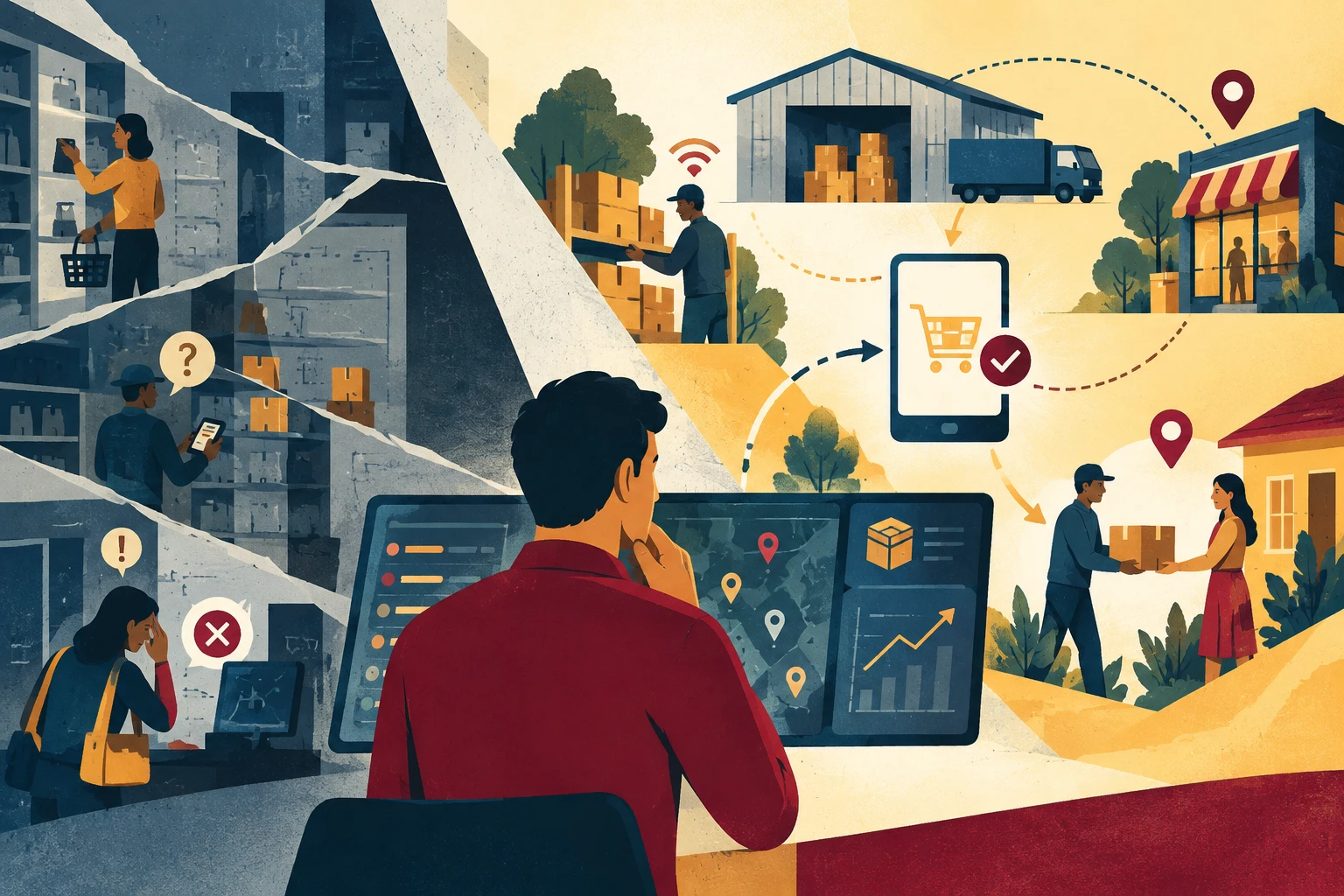
The central tension is the mismatch between physical reality and digital state. In flash sales or peak trading, even a three-minute sync lag causes massive overselling or premature cart abandonment.
Anatomy of the bottleneck
04 — Deterministic vs. probabilistic
| Dimension | Traditional deterministic | Modern probabilistic |
|---|---|---|
| Data philosophy | Binary — in stock or out. | Confidence scoring, P(stock) = 94%, from velocity, location and shrink. |
| Sync mechanism | Scheduled batch files or REST polling loops. | Event-driven CDC over streaming buses (Kafka, EventBridge). |
| Safety buffers | Static thresholds — reserve 5 units per store, universally. | Dynamic safety stock per SKU, velocity and store risk profile. |
| Checkout guardrails | Hard availability check at payment authorization. | Intent-based distributed soft-locks at cart entry with TTL expiry. |
05 — Why execution has fallen short
Event-driven architectures and probabilistic models are conceptually sound. Three practical barriers have delayed broad enterprise adoption.
Legacy POS & WMS infrastructure
Most stores run relational databases installed 15–20 years ago with no native event streaming or CDC. Upgrading a 1,000-store footprint is a multi-year, capital-heavy project.
The physical–human disconnect
No algorithm predicts a shopper picking up an item in aisle 2 and leaving it in aisle 8. The associate dispatched for a ship-from-store pick cannot find the item despite high system confidence.
Organizational & P&L misalignment
E-commerce and store operations run on separate P&Ls. Managers penalised for missed picks quietly hide stock from online fulfillment.
06 — Strategic action plan
Three enablers finally make this architecture deployable at enterprise scale.